Why Spoken Argument Is Harder Than Written Argument
Speaking forces you to plan, produce, and adapt language simultaneously.
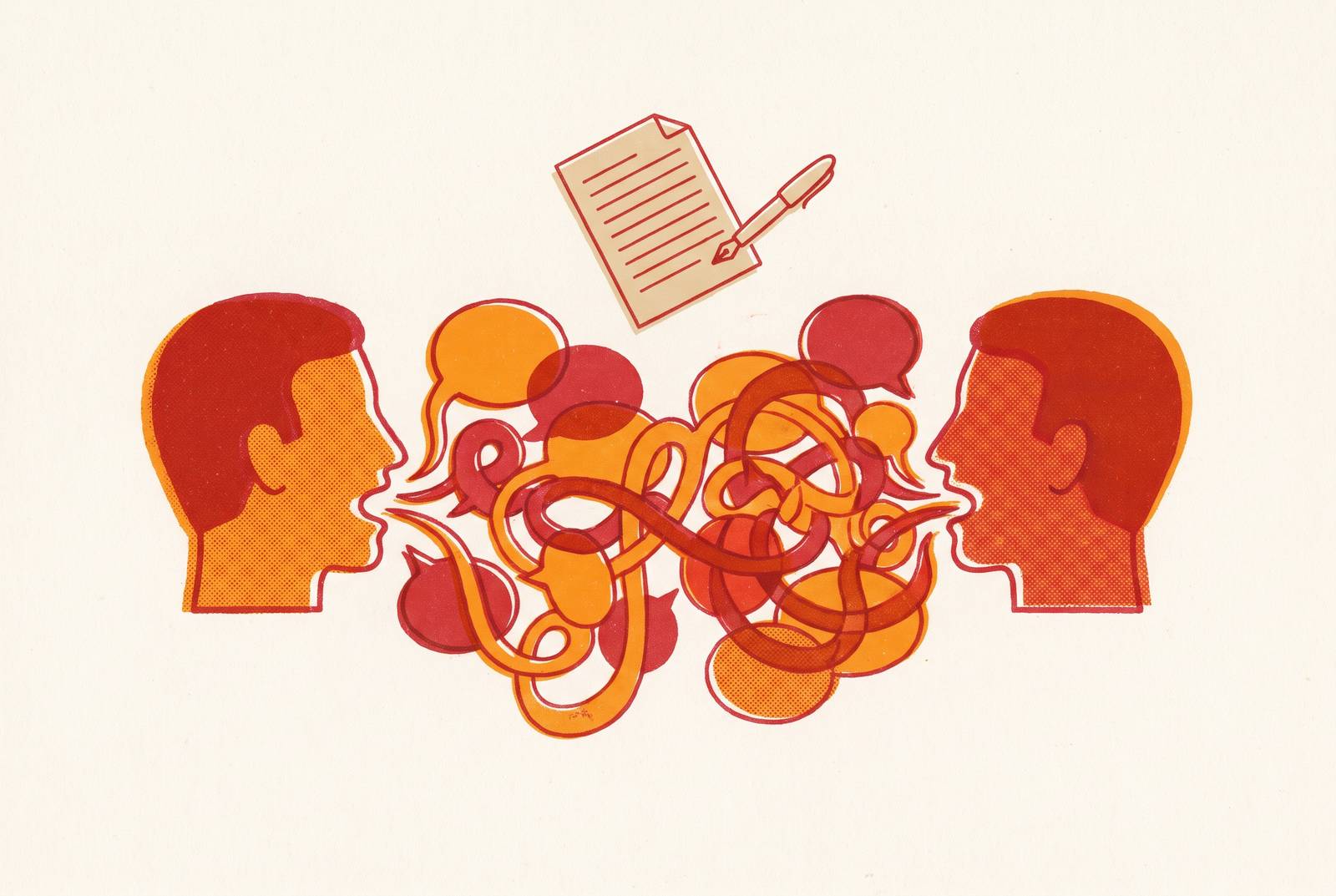
Spoken argument is harder than written argument because it requires planning, expression, and adaptation at the same time. The gap is structural. Understanding that difference changes the training task. Closing it requires practice in real-time speech production, live response, and listener-oriented structure, rather than further refinement of an argument on the page.
Why spoken and written argument use different cognitive systems
Writing and speaking use neural systems that overlap but are distinct. They are not interchangeable routes from knowledge to expression. Writing engages the brain’s executive control network, supporting deliberate analysis, planning, and restructuring before words are committed. The writer can examine a claim while leaving its wording unfinished, or revise a sentence after seeing how it relates to the next one.
Speech production compresses those operations into a few hundred milliseconds. The speaker must formulate a thought, select words, arrange them grammatically, coordinate motor output, and monitor the result through auditory feedback. As one sentence is delivered, the language needed to continue must already be taking shape.
Because this process moves so quickly, speaking depends on procedural automaticity. With well-practiced language patterns, the speaker does not have to control each step deliberately. So familiar material is easier to express fluently, while material that is unfamiliar or complex needs more conscious attention. The difficulty is producing the language for a thought while the rest of the speech process remains active.
This asymmetry explains why most people are meaningfully stronger in one mode than the other. It does not establish that one cognitive tool is universally superior. A written argument can be revised at the writer’s pace, while a spoken argument must be put into words and adjusted on the spot. Argument exposes that distinction sharply because a speaker must preserve the reasoning while keeping the words flowing.
What the real-time constraint removes from the arguer
The revision cycle is the decisive affordance that real-time speech removes. Writing models distinguish planning, translating ideas into text, and reviewing what has been produced. Revision is a normal stage for making corrections, even when the reasoning was sound to begin with. A writer can find a missing premise, move it earlier, and give the reader the repaired argument without showing the version that was set aside.
A speaker cannot make that kind of replacement. A correction can follow an earlier statement, but the listener has already heard the statement being corrected. Planning, production, and review must therefore operate together, rather than serving as stages through which the argument can repeatedly pass. Monitoring remains possible, but it happens during delivery, without the writer’s freedom to stop and reconstruct the whole.
Working memory must support the resulting overlap. In an exchange, the speaker may need to retain the opponent’s last point, construct a counter-argument, and continue delivering sentences already underway. Each task competes for attention at the same moment. Argument makes this especially hard because the reply must answer a specific claim and keep the link between evidence and conclusion.
The resulting loss of quality need not reflect any loss of understanding. In an educational assessment, that difference can appear as a lower grade band when the mode changes from written to spoken, even though the underlying knowledge remains intact. Treating the result solely as weak preparation misses the constraint that produced it.
How oral argument compounds difficulty through its interactive demands
Martin Luginbühl and Daniel Müller-Feldmeth’s 2022 paper, Oral Argumentation Skills between Process and Product, identifies a further demand of face-to-face argument. Oral argumentation is sequentially organized and interactively processed. Participants must work out with each other what each turn does in the conversation and the argument, as well as understand what its words say. A contribution has to fit the exchange as it now stands.
That requirement makes a response more than a prepared argument delivered at the right moment. The speaker must work out what the opponent’s turn is doing before deciding how to answer it. Its argumentative role, its relation to the participants, and the position it takes toward knowledge all shape the response.
The paper’s account also explains why there is no generic good argument that travels unchanged between exchanges. Every turn must be adapted to the current situation and the particular participant. A point developed in advance may remain logically sound yet need substantial reformulation to address what has just been said.
Written argument generally converges toward a fixed product that can be refined before presentation. Spoken argument is co-constructed by participants whose contributions can redirect it. Neither participant controls the whole course of the discussion. The speaker must consequently track the changing conversational frame while continuing to produce and monitor language.
This adds interactive demands to those of speech production. Luginbühl and Müller-Feldmeth locate oral argumentation skills in the process as well as the product. An effective contribution must be sound and responsive to the turn that made it relevant.
Why listeners add a structural burden that readers don't
Listeners cannot look back over a spoken argument as readers can look back over a page. Its exact phrasing disappears as it is delivered, and listeners often grasp the reasoning in fragments. A reader can return to an earlier premise and reconstruct a dense passage. The speaker cannot assume that opportunity exists.
Oral argument therefore requires explicit signposting, repetition, and reformulation. Metadiscourse markers such as “to sum up” tell listeners what a passage is doing, while reformulation gives them another route into a key point. These are structural supports. They help listeners follow multi-step reasoning when they can no longer look back at its earlier steps.
This audience burden sits on top of production and interaction. The speaker must shape a response to the opponent while also making its place in the argument clear to the listener. A written passage cannot simply be transferred into speech with its structure untouched. That difference helps explain why preparation can be thorough yet still leave crucial parts of oral performance unrehearsed.
Why written preparation does not transfer to spoken argument performance
Written preparation develops an argument under conditions that spoken performance does not provide. Planning can precede expression, phrasing can remain provisional, and review can interrupt production whenever needed. A practitioner who prepares only by writing becomes more accomplished at working within those conditions. The oral task asks for something different.
Transfer-appropriate processing predicts a shortfall when practice does not rehearse the operations required during performance. Knowing the content is useful, but it is not equivalent to having practiced its spoken production. Written fluency on a topic does not by itself build the automatic language patterns needed to discuss that topic aloud. Familiarity with the reasoning and fluency in expressing it are distinct achievements.
This distinction explains the apparent contradiction of feeling underprepared after extensive preparation. Even when an argument has been worked out with care, its premises settled and its wording polished, saying it aloud may still take too much conscious attention. Under questioning, the speaker must also depart from that prepared sequence. The difficulty lies in coordinating these operations.
A common objection is that complete command of an argument should make delivery straightforward. That would follow if speaking were only retrieval. In an actual exchange, however, the speaker must retrieve and formulate content while monitoring delivery and responding to another participant. Knowing the argument does not remove those simultaneous demands or make them automatic.
Further written refinement leaves the missing operations unrehearsed. A well-developed argument supplies the content of practice, but not the practice itself. Training must therefore target real-time production, interactive adaptation, and structure for a listening audience.
What training for spoken argument actually targets
The training response is to rehearse the operations that the spoken task requires. Practicing aloud builds automatic language patterns for specific content in ways that scripts or silent review alone cannot. The more a topic has been expressed aloud, the less conscious attention its familiar language demands.
Solo drills can isolate parts of this workload. Recording a practice speech and tracking filler words makes real-time production available for examination after the attempt. The recording gives the speaker concrete evidence of delivery to assess.
Structured practice can also separate the tasks that compete during a round. Unpacking a motion, identifying the key issue, prioritizing arguments, and signposting for a listener each address a different part of oral performance. Practicing them separately allows attention to be directed at the specific operation before they are combined. The goal is not simply to produce more speech, but to make the necessary operations more dependable under load.
A real opponent takes turns whose content and direction the speaker cannot know in advance. Live rounds rehearse the need to interpret those turns, adapt a response, and sustain an argument through an exchange. Prepared delivery cannot reproduce that unpredictability.
Luginbühl and Müller-Feldmeth treat process-related and rhetorical conversational aspects as part of oral argumentation skills. Assigned-side practice also asks speakers to argue against their own views. Keeping emotional reaction separate from analytical reasoning makes practice more like debate than defending a view the speaker already holds over and over.
Why scored, judged rounds close the gap faster than unstructured practice
Unstructured practice can rehearse speech without establishing whether the argument worked. A speaker may finish a response and speak fluently yet get no feedback on whether the reasoning landed. Delivery alone cannot answer that question. A scored, judged round adds an outcome against which the performance can be assessed.
The comparison with chess is useful because moves acquire their significance within a contested game. Practice needs a real opponent, an unpredictable exchange, and a result that reveals more than the player’s impression of the moves. Learning to adapt in spoken argument needs these same parts. A verdict connects the choices made during an exchange to an assessment of their effectiveness.
AI judging can give people outside institutional debate programs access to scored practice. When a round ends with a written decision citing what was actually said, the speaker has a record-based account of which arguments landed and which did not. The decision can direct attention toward the spoken performance rather than the stronger version of the argument that existed in preparation.
The usefulness of that judgment depends on calibration. Criteria published before the round, applied consistently, and open to appeal make the verdict more accountable than a general impression. The speaker can examine the decision against both the criteria and the record.
A live 1v1 format lets speakers interact in real time, while a leaderboard ranked by best score shows how their performance was judged. These elements serve different purposes. The live exchange recreates the co-constructed conditions identified by Luginbühl and Müller-Feldmeth, while the judged outcome provides a basis for assessing improvement. Together, they make practice answerable to the task that written preparation cannot reproduce, namely responding to an opponent in language that a listener can follow as it is spoken.