What Happens When You Debate a Stranger on a Timed Topic
Timed debate against strangers reveals skills that ordinary argument never tests.
Debating a stranger on a timed topic is not a faster version of ordinary disagreement. It is a distinct cognitive event, one that combines an unknown opponent, a fixed clock, and a live verdict into conditions that ordinary conversation or written argument never replicates. What happens in that environment, round by round, is what separates people who improve from those who merely argue louder.
A stranger brings zero obligation to be polite about weaknesses. A friend in an argument will hesitate before exploiting a gap in your reasoning. A stranger will walk through it without compunction, because they have no stake in preserving the relationship. That absence of goodwill changes the texture of everything said afterward.
The clock compounds the pressure. In ordinary disagreement, a person can pause, think, and formulate a response without visible cost. In a timed round every second you hesitate is a visible cost charged against you. Thinking and speaking collapse into a single act. There is no interval in which to privately rehearse a response before delivering it.
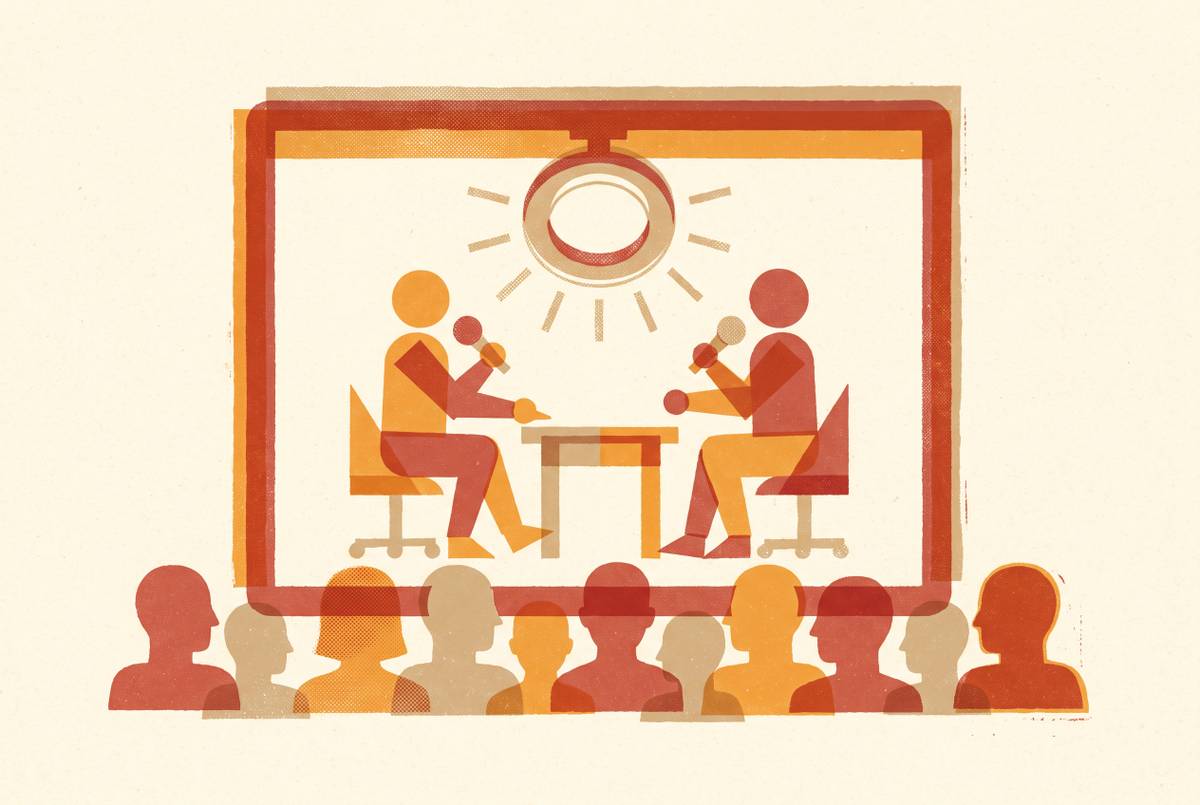
A verdict is coming regardless. A dinner-table argument trails off into silence or a change of subject, but a judged round ends with a score and a written explanation. The participants know this from the first word. That knowledge shapes posture, pacing, and the willingness to take risks. It makes the event a training environment rather than merely an argument, because the feedback loop is built into the structure.
What actually happens in your head during the first speech
The opening speech under time pressure exposes a gap that most people do not know exists. It is the difference between knowing an argument in the abstract and being able to deliver it while a clock runs and a stranger waits to dismantle it. The first speech is where that difference announces itself.
The instinct under pressure is to assert. What gets dropped first is the warrant, the actual reasoning that connects the claim to its support. A complete argument requires three components: a claim, a warrant, and an impact. Spoken delivery under pressure reveals it immediately.
There is a diagnostic that follows from this. When the claim is the longest part of what was said, the speaker was asserting. When the warrant is the longest part, the speaker was constructing. The distinction is audible to any experienced judge.
Confidence feels like competence from the inside. The stranger judge, who has no loyalty to the speaker and no investment in their success, will notice the difference immediately. That is the ruthless efficiency of a stranger as an audience. They hear what was actually said, not what the speaker intended to say.
Verbal static compounds under pressure. Each "um" costs a small amount of authority. A stranger opponent will exploit hesitation in ways a friendly partner in practice never would, because a stranger is actively looking for the moment to strike.
Signposting is the habit that keeps a speech coherent under pressure. Explicitly telling the judge where the argument stands, "two responses here, first," gives the speech a visible architecture. The judge or opponent loses the thread, and the speaker has no way to recover it.
Why listening to a stranger argue is harder than it looks, and why it determines the round
The hardest skill in timed debate is not speaking under pressure. It is listening accurately enough to respond to what the stranger actually said rather than what was expected. This runs counter to intuition, because the visible half of debate is speech. But the determining half is listening.
A dropped argument is treated as conceded by a judge. Keep the flow, and you win arguments the other debater did not even know were still live. That is the mechanical consequence of listening. If the opponent never answered a point, the judge records it as conceded, whether or not the opponent noticed the omission.
Flowing is the skill that makes this possible. It is structured note-taking that maps each argument across the round in columns, so a debater can see what was answered and what was dropped. A flow sheet can. It is the external scaffold for accurate listening.
Listening to a stranger requires suppressing an instinct that feels natural. A debater who listens to respond hears the opening and the conclusion. A debater who listens to understand hears the full architecture.
A stranger's framing is genuinely unknown. Catching that reframe early is what allows a debater to contest it rather than argue past it. Miss the reframe, and the rest of the round is spent shadowboxing an argument the opponent never made.
The practitioner literature offers a takeaway that ought to redirect attention. Not constructing better cases. Catching more.
The rebuttal moment: when the stranger says something you didn't prepare for
How a debater handles the argument they did not prepare for is the single most revealing moment in a timed round. It is also the moment that deliberate practice is specifically designed to reach. Everything prior has been preparation. This is improvisation under fire.
The weak response is to refute the easiest point, the decoration, not the argument the opponent's whole case rests on. Inexperienced debaters gravitate toward the decoration because it is easier to answer. Experienced ones find the wall.
The four-step refutation move gives structure to improvised rebuttal. It runs: name the argument, state the response, warrant it, weigh it. The formulation serves as a spine for every rebuttal under pressure, so the debater can follow a pattern instead of inventing a format and a response at the same time. The underlying sequence is simple enough to hold in memory: they say, but, because, therefore.
The steel man discipline builds credibility with a judge. Dismantling a straw version signals either dishonesty or poor listening. Dismantling the strongest version signals competence and respect for the exchange.
Fallacy recognition is a structural shortcut. The debater can dismantle the argument without disputing any of the facts, which saves time under a clock. It is the most efficient refutation available, because it attacks the connection rather than the evidence.
Deliberate practice targets this exact moment. This is not general repetition. It is targeted repetition of the specific failure point, the moment where the prepared script ran out and improvisation took over.
What weighing and framing do that most debaters never learn to do
In a close round against a stranger, both sides will have standing arguments at the end. The debater who tells the judge how to compare those arguments, rather than leaving the comparison to chance, holds a structural advantage that pure argument quality cannot overcome. Comparison is the act that decides the round.
Weighing is explicitly comparing impacts across dimensions. Sequencing asks which impact triggers the other. These dimensions give the judge a language for comparison that does not rely on intuition.
Framing is setting the question the round is actually about. A debater who successfully frames the round has pre-decided which arguments are relevant and which are peripheral, before the judge makes that call independently. The entire round is then played on the framer's terms.
This is the most under-taught skill in debate. Yet the comparison is what the judge is literally deciding. The oversight is glaring once it is named.
Against a stranger this matters more, not less. Preparation equalizes before the round. Adaptability decides it.
Most beginners plateau here. They improve argument construction and delivery, then stop improving. It is because weighing needs comparative judgment, not advocacy. Practice rounds build this habit only if you make it explicit. Without that explicitness, the plateau is the ceiling.
How a scored verdict after the round changes what you take away from it
A round without a verdict is practice. A round with a scored, explained verdict is feedback. The design of the verdict determines whether that feedback is usable or not.
Human judging has a consistency problem. Humans get tired, distracted, or swayed by charismatic delivery. They often leave vague comments, such as "good point," that give the debater nothing to act on. A vague verdict is not feedback. It is a score without a lesson.
The fairness conditions that make a verdict trustworthy are specific. Scoring rules must be published before the round begins, not after. A multi-model panel reduces the influence of any single model's idiosyncrasies. An appeal path to a human reviewer handles edge cases. These conditions are what distinguish a verdict from an impression.
The strongest objection to automated judging is that it may penalize a brilliant but unconventional argument for not fitting a template, and that it can inherit biases from training data. The emerging consensus is a hybrid approach. Automated systems handle consistency and speed, and human reviewers handle calibration and edge cases. This division of labor preserves the scalability of automated scoring without sacrificing the judgment that unconventional arguments sometimes require.
Three habits most improve performance between rounds. Watching recordings of one's own speeches. Practicing impromptu rebuttals on unfamiliar motions. Reading judge feedback for patterns across multiple rounds. You can only read patterns in a verdict specific enough for it. A vague "good point" supports none of them.
How topic choice shapes the cognitive experience before the first word is spoken
If the topic is poorly chosen, the cognitive experience of timed debate collapses before it begins. Genuine two-sidedness is not a nicety. It is the structural prerequisite for everything else in a timed round to function.
Topics that rest on pure definition produce definitional arguments, not reasoning under pressure. "Is a hot dog a sandwich?" is the canonical example. The cognitive demands of an earlier section, the load-bearing walls, the weighing, the framing, simply do not arise, because both sides are disputing the boundary of a word rather than the merits of a position.
One-sided topics break the same way, from the other direction. The debater assigned the losing side is not practicing reasoning. They are practicing losing gracefully. The exercise collapses into a performance of disadvantage.
Party politics, religion, and topics that put a school or workplace speaker in a difficult position are excluded from well-designed topic banks. The reason is not sensitivity. It is that these topics test tribal loyalty rather than reasoning. A debater arguing on behalf of their tribe rehearses allegiance. A debater arguing against it rehearses defection. Neither is reasoning.
The counterintuitive expert advice on side selection follows directly. Argue the side you disagree with. That is where real skill develops, because the debater must construct arguments they cannot borrow from existing beliefs. Beliefs are shortcuts. Remove the shortcut and the reasoning must be built from scratch.
The best debaters argue the other side until they understand it well enough to teach it. If the only topics run are those that confirm what is already thought, the activity is rehearsal, not debate. Rehearsal confirms. Debate changes.
Why repetition alone doesn't close the gap — and what deliberate practice in timed rounds actually requires
You do not close the skill gap between knowing these techniques and performing them under time pressure against a stranger through repetition. You close it with deliberate, feedback-driven repetition that targets specific failure points round by round. Deliberate practice applied to debate follows a defined method. Simulate the real environment. Keep prep time minimal to expose technical inefficiencies. Record and review the exchange. Identify exactly where hesitation or weak evidence appeared. Return specifically to those sections. This is targeted repetition, not general repetition. The distinction is the entire point.
The structured training sequence from competitive coaching proceeds in stages. Argument construction drills until the claim-warrant-impact structure is automatic. Flowing recorded rounds for accuracy before speed. Writing four-step responses to flowed arguments. Only then layering weighing, framing, and delivery onto full practice rounds. Each stage builds on the one before it, and skipping a stage leaves a gap that pressure will expose.
Live one-on-one debate against strangers adds the specific unpredictability that solo work cannot replicate. A solo drill can simulate speed. It cannot simulate the surprise of an argument that never came up in preparation. That unpredictability is exactly the condition under which the skills described earlier are actually tested. The stranger, the clock, and the verdict are not incidental features of the format. They are the training stimulus itself, and removing any one of them removes the thing that produces improvement.