Best Debate Topics for First-Time Debaters
A guide to picking motions that give beginners real arguments.

The best debate topics for first-time debaters are specific, two-sided, and close enough to daily life that both sides can explain their reasoning. Choosing one is the first argument skill a beginner learns. A useful motion does more than invite opinions. It gives opposing speakers room to build warrants, test consequences, and explain why their position should prevail.
Why the topic you pick is already an argument decision
“Should people be nice?” offers little room for disagreement. “This house would replace homework with a longer school day” creates an immediate choice between competing arrangements. The second motion gives both sides something defensible to protect and something consequential to challenge. It creates clash before either speaker starts to prepare.
A beginner can test a motion by naming a thoughtful, well-informed person who could defend each side. Both positions need a credible advocate. If one side requires bad faith, the topic will reward agreement. Difficulty must also fit the format, because a first round should keep content recall manageable and leave enough attention for structure and delivery.
Four criteria that separate a workable motion from a dead one
The first check is whether two reasonable sides exist. Each position must be defensible without turning its advocate into a strawman. This is a test of balance. A motion can produce strong disagreement and still fail if one side has no credible reasoning available. In that case, drop the topic, since a beginner would have to manufacture a case.
The second check concerns what the disagreement can settle. “Is the Earth warming?” has a scientific answer, while “Should rich countries pay poorer ones to cut emissions?” requires judgments about costs, values, and obligations. Facts inform the latter without deciding it alone. Policy, value, and prediction motions offer this room for argument. By contrast, “a hot dog is a sandwich” mainly tests definitions, making it more useful as a warm-up than a full round.
The third check is clear, narrow, neutral wording. “Technology is bad” leaves almost everything open, whereas “This house would ban smartphones for students under 14 during the school day” specifies the people, change, and timing. Loaded wording creates a different defect. “Cruel practice of zoos” preselects a conclusion that “this house would close zoos” leaves open. The “This house would / believes / regrets” convention helps expose the burden of proof, including the obligation to justify a proposed change.
The fourth check is accessibility without specialist knowledge. For a first debate, a beginner should be able to think of two reasons on each side without looking anything up. Research can strengthen those reasons later. If neither side can begin without technical preparation, the motion is consuming attention that should go toward learning how an argument works.
Icebreaker and everyday-life topics for the very first round
Icebreaker motions put participation ahead of winning. “Pineapple belongs on pizza” and “Cats are better pets than dogs” provide immediate positions without research. “Breakfast is the most important meal of the day” offers another familiar starting point. Speakers must turn a preference into a reason that another person can examine, including when they have been assigned the side they dislike.
“Daylight saving time should be abolished,” “Tipping culture should end,” and “Social media has made friendships shallower” move beyond taste while remaining close to ordinary experience. Physical books versus e-books, a big city versus a small town, and being an early bird versus a night owl all require speakers to explain what makes one option better.
The next step is to make those standards explicit. Debating whether pets should be allowed in all workplaces takes more than a liking for animals. Likewise, whether cooking at home is always better than eating out demands attention to the word “always.” Scope becomes part of the argument itself. These motions establish a starting level from which beginners can progress.
School and education topics that give beginners real arguments to make
In the elementary-level tier, suitable choices include banning homework, banning junk food in schools, requiring every student to learn a musical instrument, and having a class pet. Phones before the age of 10 offer another familiar question. The subjects are accessible, but speakers still need to distinguish what they enjoy from what they can justify.
The middle-school tier brings in more clearly defined choices about how schools work. “This house would let students choose their own seats in class” and “This house believes school uniforms do more good than harm” are particularly accessible beginner motions. Other choices are to ban junk food from school vending machines, make recess longer and lunch shorter, allow phones at lunch but not in class, and let students grade teachers once a term. Questions about standardized testing, class rankings, and the relative importance of the humanities and STEM demand broader comparisons.
At the high-school level, strong options include banning smartphones for the whole school day, starting high school no earlier than 9 a.m., requiring community service for graduation, and requiring a course in personal finance. The smartphone and personal-finance motions are still easy for beginners to take on. The phone ban and later-start motion are especially well bounded because they identify a mechanism and affected groups, including students, teachers, and parents. Their trade-offs extend beyond personal preference. How well students learn and how schedules would change give both sides grounds to build full arguments.
Technology and work topics that reward a little research without requiring expertise
Technology motions call for some background knowledge, though speakers may not need to be experts. Good places to start are whether children should have smartphones before age 13, whether online classes should replace traditional classrooms, and whether social media accounts should have age limits. Online anonymity and ID-verified accounts for users under 18 bring in policy choices that are harder to debate. These topics reward a little research. Repealing Section 230 protections for social media platforms belongs at the harder end, where understanding the policy becomes part of preparation.
AI use in school essays is an easier place to start. In 2026, the controversy is accessible through students’ own experience, while the conflict between academic integrity and tool adoption gives both sides a substantive case. Familiarity gives beginners a place to start reasoning before evidence refines their claims.
Work motions turn to choices students may soon face. “This house believes remote workers should be paid the same as office workers” is a beginner-accessible option. Publishing every employee’s salary inside a company and reducing the work week to four days provide more demanding alternatives. Both have concrete mechanisms and identifiable affected groups. They also leave room to disagree over what the evidence shows, so evidence can make a case stronger without settling it on its own.
Other choices are to pay college athletes like professionals and pay artists more per stream. Requiring a four-day workweek by federal law makes the reach of the policy clearer, while government mandates to close the gender pay gap are harder to weigh against market forces. Research here replaces assumptions with warrants that can withstand an opponent’s questions.
Harder policy topics for beginners ready to argue with evidence
Beginners are ready for policy motions when they can build a case and answer a reason from the other side. “AI systems should be banned from autonomous decision-making in hiring” specifies both a technology and a decision-making role. That boundary gives research a clear target. The debate concerns a defined use of AI rather than whether artificial intelligence is good or bad in general. The benefits and harms of AI in healthcare offer another option, but require a wider comparison.
“This house believes elite universities should drop legacy admissions” is also beginner-accessible despite its policy complexity. It identifies an institution and a practice that can be defended or challenged. Other education-policy options include tuition-free universities, a voting age of 16, real budget authority for student government, and removing the connection between sports and academic eligibility. These motions need more than personal preference. They make speakers show how the evidence bears on the specific change being proposed.
Economic and social-policy choices include a universal basic income in the U.S., wealth taxes on the ultra-wealthy, mandatory national service after high school, and a ban on junk food advertising. A legal right to repair what people own offers a more bounded ethical-policy question. The same selection checks still apply. “Is capitalism good?” is too broad, while raising the federal minimum wage identifies a decision that a prepared beginner can meaningfully contest. Technical complexity should serve the argument.
Fun and hypothetical topics worth keeping in the rotation
Funny motions bring out skills that can get lost in serious topics. “Invisibility is a better superpower than being able to fly” requires a standard for judging usefulness before either speaker can establish superiority. “Hard work is more important than talent” similarly requires a preference grounded in value framing. Neither topic needs a policy briefing. Both demand consistency about what counts as a good reason.
“Should superheroes be held legally responsible for property damage?” adds consequentialist reasoning, requiring speakers to follow a position through its implications. Choosing between unlimited money and unlimited time is another way to think through what matters most. These belong in opening club rounds, competitive warm-ups, and first-ever debates where participation takes precedence over rigor. Their informality serves a clear teaching purpose. The skills of defining terms, choosing standards, and working out what would follow carry straight over into serious rounds.
What argument structure looks like on a beginner topic
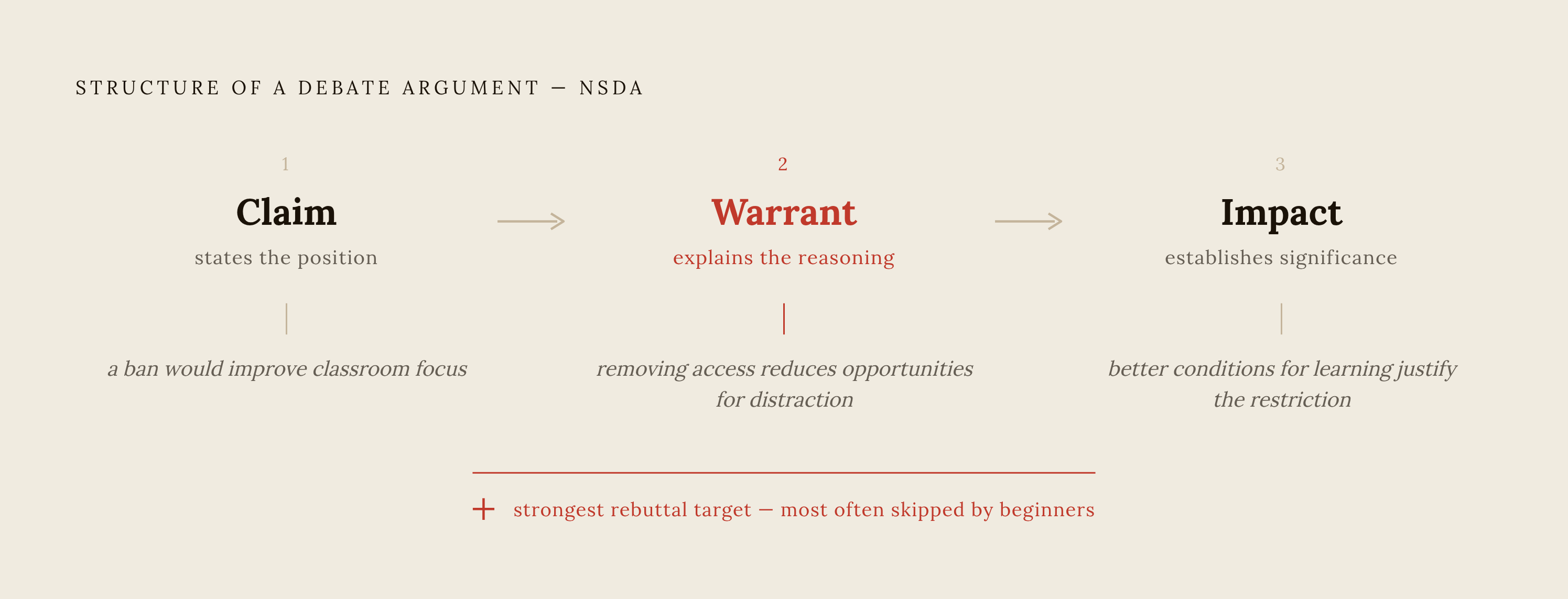
Once the motion is chosen, preparation shifts from selection to execution. The NSDA’s Debate Training Guide identifies three elements of an argument, which are claim, warrant, and impact. The claim states the position, the warrant explains the reasoning, and the impact establishes its significance for the resolution. Each part has a separate job. Evidence supports the reasoning but cannot replace an explanation of what it proves.
For the school smartphone motion, a possible argument is that a ban would improve classroom focus as its claim, that removing access would reduce opportunities for distraction as its warrant, and that better conditions for learning would justify the restriction as its impact. That case needs testing. An opponent can challenge whether the proposed restriction produces the claimed benefit or whether that benefit justifies its scope. The motion makes those challenges possible because its mechanism is clear.
For a first round, state the claim before presenting evidence, then explain the impact in ordinary language. Rebuttal should test how the facts support the conclusions. Even if an opponent’s evidence is accepted, the conclusion may not follow from it. Attacking that warrant is usually stronger than merely asserting the opposite position. Explain the best one or two arguments in full rather than giving six arguments too little attention.
Delivery should make the structure easy to hear. Slow down, pause after key sentences, and signpost transitions between points. Use bullet notes rather than a script to keep the focus on the audience. A simple two-person format is enough to begin, with an opening, rebuttal, and closing for each side. Public Forum extends that skeleton with crossfire periods, summary speeches, and a final focus, but those additions are not prerequisites for practicing a complete argument.
How to practice a topic before you argue it in front of anyone
Rehearsal begins by arguing both sides of the motion. Write one sentence stating a claim for each side, then identify two warrants supporting each claim. Next, select the opposing warrant that would be hardest to answer. That is the crux of the preparation. It directs attention toward the strongest disagreement rather than toward accumulating points that an opponent can dismiss easily.
Arguing the side a speaker rejects is especially useful because it requires the strongest version of the opposing case. That work gives rebuttal a precise target. Run a sample round before bringing the motion to a club or classroom, since apparent balance can collapse under questioning. If one side cannot sustain its reasoning, the topic needs reconsideration. Testing the motion protects the session from becoming an exercise in defending the indefensible.
Structured practice, including practice with an AI opponent, can provide a setting for that rehearsal. The argument remains the standard for judging practice. State the warrant and impact in two sentences, then subject them to a round of questioning. An argument that cannot survive that test is not ready for delivery. A motion earns its place in a first debate by making that exchange possible for both sides.