What AI Judges Penalize That Human Judges Often Miss
AI judges catch logical gaps that confident delivery lets human judges miss.
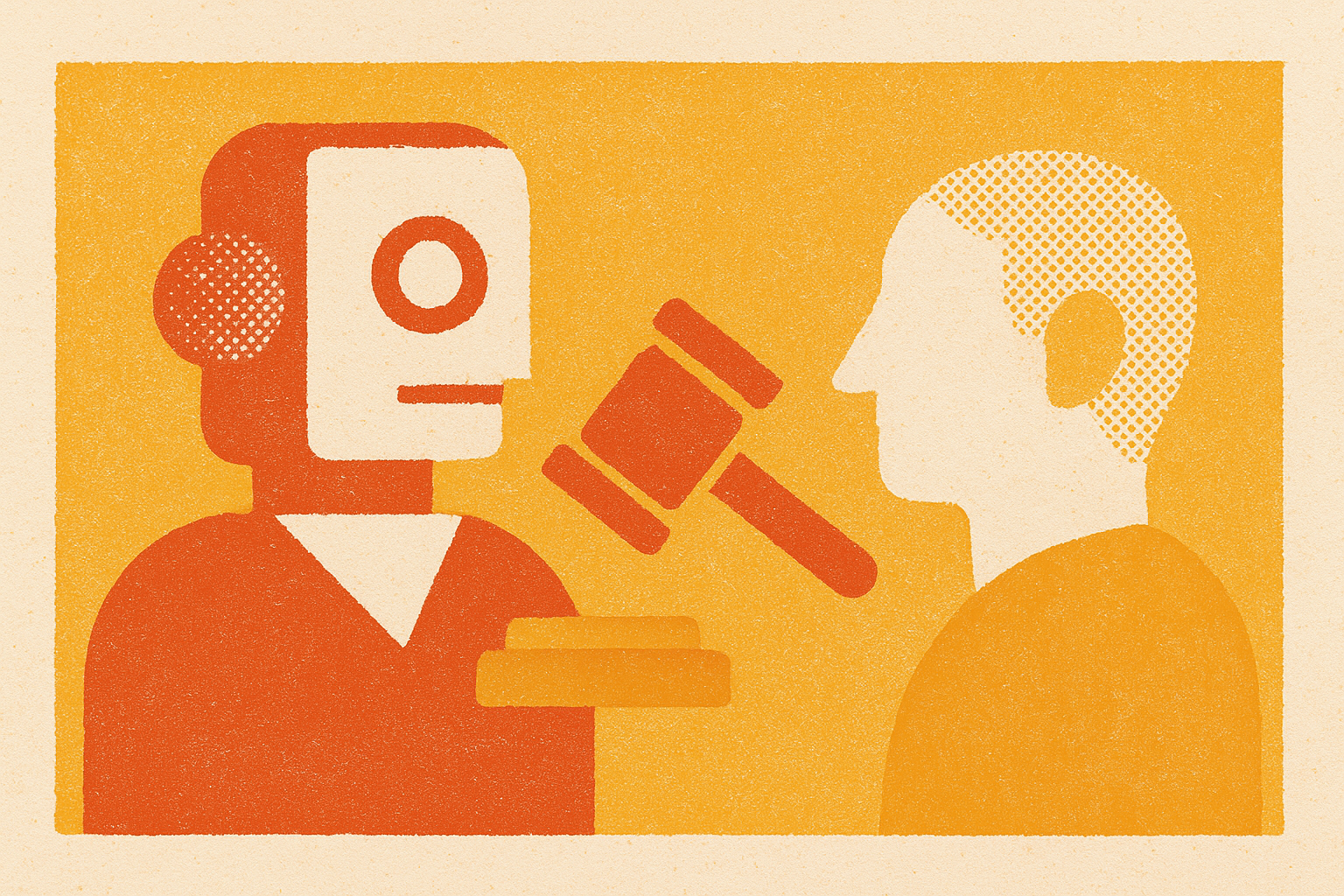
Every debater who has stepped out of a round convinced they won, only to hear a split decision go the other way, has run into the same structural fact: human judging has no single, shared standard. Public Forum debate in particular draws judges from wildly different backgrounds, retired engineers, parents filling an open slot, former competitors who debated a decade ago under a different format, and each one carries a private sense of what a "good argument" sounds like. A paradigm sheet might tell a debater how a judge likes flow or speed, but which argument will land emotionally or which delivery style will read as confident depends on the individual judge.
Even judges who sit on the competitive circuit full time, who have seen hundreds of rounds and built real expertise, are still human in the ways that matter here. They get tired by the fourth round of a Saturday tournament. They get pulled along by a debater who talks fast and sounds sure. They fixate on the one argument that happens to touch something in their own experience, and let it carry more weight than the flow actually supports. None of this makes them bad judges. It makes them judges, which is to say people, and people respond to a whole performance, not just the logical content of it.
The consequence is that a debater can build a case riddled with unsupported leaps and win on delivery alone, while a debater with tighter reasoning loses because they read flat and monotone. This isn't a rare failure mode that shows up once a season; it's the baseline condition of every round, genuine uncertainty about what this particular human being, sitting in this particular chair, will find convincing. And the uncertainty isn't random. It clusters in predictable places, around delivery bias, around familiarity bias toward arguments that match a judge's existing worldview, and around what amounts to a confidence heuristic, where fluency gets mistaken for soundness.
What AI judging measures, and in what order
AI judging starts from a different premise: apply the same criteria, in the same order, to every argument, regardless of who's delivering it or how. Instead of absorbing a round as one impression, an AI judge works from a rubric, scoring logic, clarity, rebuttal strength, and persuasion as separate components.
Some platforms go further and run multiple AI judges independently, a panel rather than a single model, on the idea that an error one model misses might get caught by another and that each model has to justify its score. The research on this is mixed: multi-model panels can outperform a single judge on consistency, but the gains are often modest, because errors across models tend to correlate. A panel is a structural safeguard against the specific failure mode of one model's blind spot deciding the whole round, which is a meaningfully different claim than "more models means more accuracy.
What this buys a debater, whether the judge is a single model or a panel, is a scoring order that starts with structure before it ever gets to style. Logic gets evaluated on its own terms, separate from how persuasively it was delivered. That separation is the mechanism that makes the next section possible.
The specific flaws AI flags that human judges routinely wave through
Because an AI judge extracts the logical skeleton of an argument, separating premises from conclusions, mapping how one claim is supposed to support another, distinguishing a factual claim from a value judgment, it catches structural failures that a human judge, absorbed in delivery, routinely lets pass.
The clearest example is the unsupported causal leap. A debater claims rising costs caused a policy to fail, but never actually establishes the mechanism connecting the two. If a human judge already agrees with the conclusion, they may just nod along, treating the inferential step as settled when it was only asserted. An AI judge separates the claim from the evidence offered for it and flags the gap directly, because the causal claim and its support are treated as two distinct things to check against each other, not one persuasive package.
The same goes for dropped arguments. Relevance scoring tracks, speech by speech, whether a debater actually responded to their opponent's last point or just moved past it. A human judge distracted by a strong rebuttal elsewhere in the speech might not register that an entire contention went unanswered. The AI's tracking doesn't get distracted, so an argument that isn't addressed is flagged as unaddressed in the verdict, every time.
Structural gaps work the same way. A debater states a premise, then states a conclusion, and skips the reasoning that's supposed to connect them, the "trust me, it follows" move that confident delivery makes nearly invisible to a human ear. An AI judge checks for that missing middle explicitly, because it's built to look for the inferential chain.
Clarity catches a quieter failure. Jargon and run-on sentences often get a charitable read from a human judge who fills in what the debater probably meant. An AI judge scores what was actually said, so vague phrasing gets penalized.
AI judging surfaces these patterns because it applies the same criteria every round, regardless of who's judging. Human judging might catch any one of them occasionally, depending entirely on who happens to be in the chair that day. For a debater trying to improve, that difference between occasional and consistent flagging is the whole value of the feedback.
Where AI judging has a genuine blind spot
AI judging has real limits, and the honest case for it depends on naming them. A human judge can recognize when a debater is deliberately arguing a position they don't hold, using a rhetorical structure like chiasmus, or deploying some other advanced device that intentionally breaks from standard form for effect. An AI judge expects conventional argument structure, so it can read that same move as inconsistency or a logical error.
A single-model AI judge can favor the argument style it was trained on, scoring debaters more favorably when their phrasing or structure happens to resemble the model's own patterns. That's one of the clearest reasons multi-model panels with independent scoring exist in the first place, as a check against one model's stylistic preference deciding a round.
The honest way to frame all of this is that AI's blind spot sits as the mirror image of the human judge's blind spot. Humans miss structural failures because delivery and resonance crowd out the logic. AI misses legitimate novelty because it's built to expect familiar form, and something genuinely new can register as a flaw. A debater who understands both sides of that mirror has a clearer picture of where an argument actually stands than one relying on either kind of judging alone. That's also why the better platforms build in an appeal path to a human reviewer: when an AI verdict looks wrong, the appeal should center on the specific inferential claim the AI made, not just a request to overturn the score.
Reading an AI verdict to improve your argument
An AI verdict does its real work in the written reasoning, not in the number attached to it. The score is a summary; the explanation is the diagnostic that tells a debater exactly where an inferential failure occurred and what a stronger version of the argument would need to include.
Look at the logic component first, before you glance at the overall score. A low logic score paired with high rhetoric or persuasion scores describes a precise and common failure: the argument was convincing to hear but structurally weak underneath. Human judges tend to miss this pattern, and AI is built to surface it.
Pay attention to the specific language a verdict uses. A note that reads "false-cause structure in Round 3" or "premise stated without inferential support" gives a debater something to fix. A verdict worth trusting uses specific language like the former. When a verdict marks an argument as off-topic, check whether the connection to the resolution was never built in the first place or whether it was built and then dropped mid-speech, since the fix for each is different.
Across rounds, you should treat a repeated flag as a signal, not bad luck. A repeated strawman flag across three consecutive verdicts marks a habit to correct. On platforms where the verdict cites the specific passage it's responding to, a debater can trace exactly where an argument collapsed, which a vague post-round comment from a human judge rarely allows. And where a platform allows an appeal to a human reviewer, the strongest basis for that appeal is the specific claim the AI made in its written reasoning, not a general objection to the score itself.
What consistent AI judging reveals about debaters' habits
The real value of AI judging shows up over many rounds, not in any single one. Because the same criteria apply every time, you can see patterns across a season that a rotating cast of human judges would bury in noise. If a debater routinely drops their opponent's third argument, or keeps building contentions on premises they never establish, they see that exact pattern confirmed round after round, instead of being punished once at random and excused the next three times.
Human judging introduces so much variation, different judges, different paradigms, different moods on different days, that a debater can easily misread a string of losses as bad luck when the actual cause is a structural habit that produces a loss in every round regardless of who's judging. Consistent AI scoring removes that noise. The penalty that recurs in the feedback column marks the habit that needs work, not an artifact of who happened to be judging.
That's why serious debate practice looks more like training for chess than like a classroom discussion. It needs a real opponent, a real score, and enough repetition under consistent rules to see where the game actually breaks down, not just where it broke down in one round against one judge who had a particular pet peeve. And the direction this runs cuts against a common worry about AI and skill-building. Using AI to generate arguments for a debater weakens their own argumentation ability over time. Using AI to judge arguments and name their structural weaknesses builds that ability, because the first case has AI doing the thinking and the second has AI evaluating thinking the debater still has to do.
Building a practice habit around what AI judging exposes
The practical aim isn't to get good at pleasing an AI judge specifically. You can use AI's consistent application of logical criteria to find and fix the structural weaknesses that human judging tends to obscure, and once you correct them, they stop costing rounds against human judges too.
A workable starting point is simple: run a round against an opponent, human or AI, get back a scored verdict with written reasoning attached, find the one penalty that shows up most often across recent rounds, and make fixing that the explicit focus of the next round. The target is the pattern, not the score on any single scoresheet.
Solo rounds against an AI opponent lower the barrier to this kind of repetition considerably: a round can start immediately, since you don't need to schedule a practice partner, the judging comes back instantly, and you get the feedback well before the next session begins. Live rounds against a human opponent, with an AI judge scoring them, add something solo practice can't: an opponent who improvises and does the unexpected. That's where lessons drawn from AI-surfaced patterns get tested against real argumentation under pressure.
Platforms that publish their scoring criteria before a round begins, logic, clarity, rebuttal strength, and persuasion scored separately, with the verdict traceable back to specific moments in the round, give debaters the clearest possible signal to work from, because nothing about the standard is a mystery after the fact. None of this should depend on belonging to a well-resourced school program or having a coach on hand to review film. The real promise of AI-judged practice is that it's available to anyone with an opinion and the willingness to argue it out loud, on a rubric that doesn't change depending on who walks into the room.
Sources
- When AIs Judge AIs: The Rise of Agent-as-a-Judge Evaluation for LLMs
- AI Debaters are More Persuasive when Arguing in Alignment with Their Own Beliefs
- Training Language Models to Win Debates with Self-Play Improves Judge Accuracy
- AI Judges: Out of the Question
- A Theory of Post-hoc Debate Judgement
- Automated bias blind spots: Examining stereotype associations in VLM-as-a-judge paradigms