Online Debate Platforms Compared for Casual Users
Live one-on-one judged platforms give casual debaters the real opponent and verdict they need.

Most online debate platforms were not built for the person who simply has a strong opinion and wants to test it out loud. They were built for students in classrooms or for competitors training for tournaments, and the curious general user ends up caught between tools that either withhold judgment entirely or assume a background they do not have. The market has split into three tiers, each serving its own user, and the casual debater falls into none of them. One tier comes closest: live, one-on-one, judged platforms that require no prerequisite at all.
What casual users actually need from a debate platform — and why most platforms miss it
If you have a firm take on a policy question, you want to argue it against a real or credible opponent, get honest feedback, and walk away sharper. That is a concrete, modest need, and it does not require joining a team, registering for a tournament, or knowing anything about formal debate formats in advance. The casual user's entry condition is straightforward: low friction to start, no background knowledge required, a real sense of opposition, and a verdict they can trust.
That need sits at a different angle from what a competitive debater wants. A competitor needs format-specific drilling, coach feedback, and a tournament record. A student needs structured classroom assignments and group discussion tools. The casual adult with an opinion needs none of those things, and that is precisely why most platforms fail them. The tools on the market were built for one of two other audiences, classrooms or competitors, and they serve the curious general user only incidentally.
How the market has split into three tiers, and which casual users fall between them
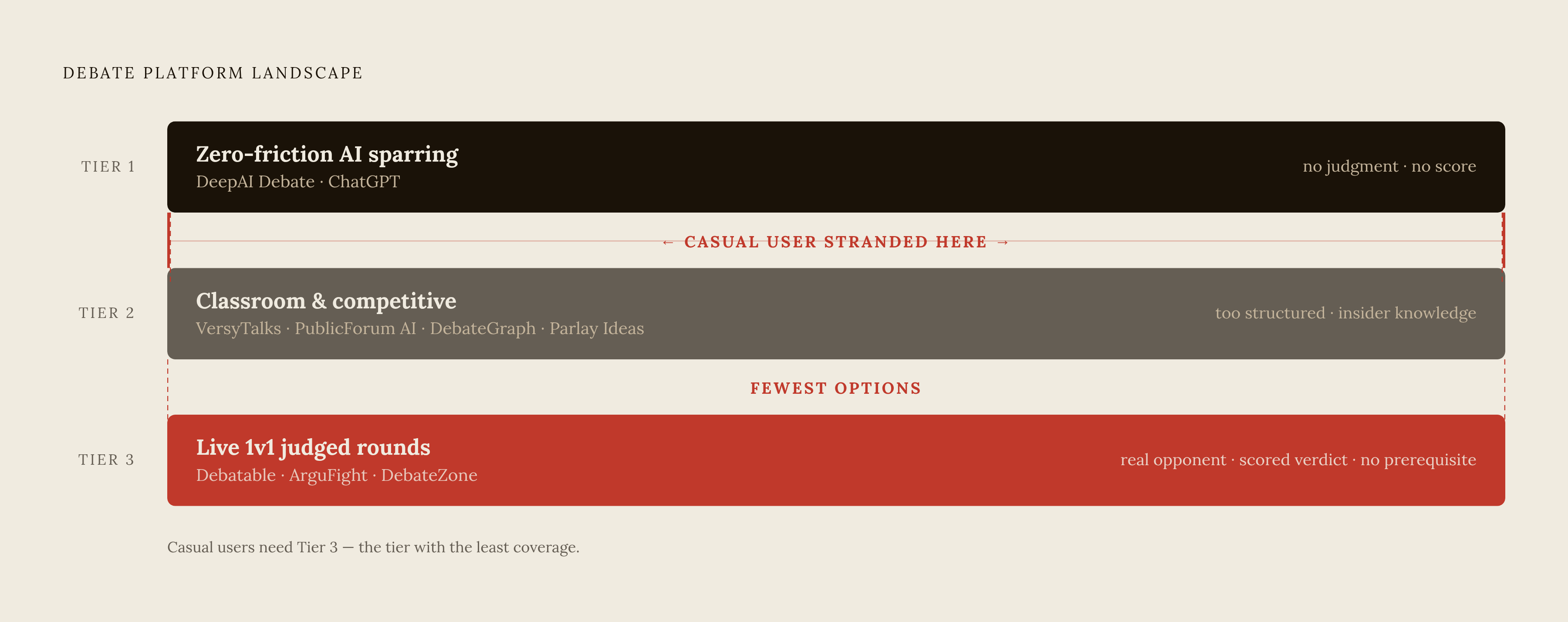
Tier 1 is zero-friction AI sparring, where the user argues with a language model and gets no score. Tier 2 is classroom and team tools for structured learning and competitive ecosystems. Tier 3 is live one-on-one judged platforms, the smallest tier and the one that most closely resembles what a casual user actually wants: a real opponent, a real verdict, and stakes that make the round feel like it matters.
The casual user falls between all three. A person who wants live spoken argument, judgment, and no prerequisite sits between Tier 1, which offers no judgment, and Tier 2, which is too structured and too insider. Tier 3 is where the answer lives, but it has the fewest options. The result is that a curious general user must patch together a substitute from tools not built for the task, often without realizing that a better fit exists one tier over.
Zero-friction AI sparring tools: what they give you and what they can't
AI sparring tools lower the barrier to entry completely, and that is their genuine contribution. They stop short, however, of the one thing that makes debate practice stick: a verdict you can interrogate. DeepAI Debate offers no account, no setup, and no live opponent. The AI argues back, but there is no judgment, no score, and no sense of consequence. It is a rehearsal space, not a proving ground.
ChatGPT sits at the more capable end of this tier. It is the strongest general model for debate preparation and argument generation, and with the right prompting it can role-play an opponent. But it has a well-documented tendency toward agreement over time, it has no built-in debate structure, and it requires significant prompt engineering to produce genuinely adversarial behavior. It is better for research than for live sparring. The structural limit of the whole tier is the absence of an external signal about improvement. Practice without feedback is rehearsal, not development.
Text-based community platforms: structured argument without the pressure of speaking live
Text-based community platforms offer real structure and real opponents, and for some casual users they are the right fit. DebateArt is free and open, with one-on-one text debates on topics from philosophy and politics to science and pop culture. You choose your topic, rules, and format, and the community gives you feedback and rankings. For someone more comfortable writing than speaking, this is a legitimate gateway.
The limitation is transfer. Writing a debate trains you differently from speaking one live. Pacing, real-time rebuttal, vocal clarity, and the ability to handle an opponent's interruption or unexpected argument are not practiced in text. VersyTalks, another text-based platform, is free to join and built around competitions and coach feedback, but it assumes you already know what British Parliamentary format requires. The genuine value of written debate is that it gives a casual user time to think, research, and construct a careful argument. The transfer problem is that a user who only debates in writing may find live rounds feel like a different activity entirely.
Classroom and competitive tools that are not designed for general use
A significant portion of debate software on the market is purpose-built for institutions: schools, coaching programs, and tournament circuits. These tools are powerful for their intended audience, but the feature sets that make them powerful actively make them confusing or irrelevant for a general user. They assume an institutional context that the casual user does not have and should not need.
VersyTalks, beyond its casual practice tools, is explicitly the competitive ecosystem for debaters, with structured tournaments, coach evaluations, team preparation, and competitive records. PublicForum AI is purpose-built for competitive Public Forum format, with speech recognition, AI flowing, and case generation tuned to PF. It is narrowly powerful for PF teams but described in the sources as not for general debate interest and complex for beginners. Argument mapping tools like DebateGraph, argunet editor, and Socratrees visualize argument structure graphically, which is useful for academic analysis but offers no opponent, no judgment, and no spoken component. Educators use Parlay Ideas for student discussions because it has pre-made prompts and analytics. None of these match a self-directed casual adult.
Live 1v1 judged platforms: the tier that actually matches the casual user's need
The smallest tier in the market is also the one that delivers what the casual user described at the outset: a real opponent, a spoken round, a scored verdict, and no prerequisite background. Debatable is the clearest example. It pairs human opponents in real time for live, spoken, timed rounds, or offers a clearly labeled AI voice round that the user can choose if no human is available. The platform never switches you to AI automatically, and you can start rounds with no scheduling or preparation. No competitive background is required. The public leaderboard ranks players by best score, with live and AI rounds marked separately, and top-ranked users can be selected to debate creators and streamers live. That community layer gives you a reason to come back after one round.
Debatable directly fills this gap because it is a voice-first one-on-one format where you argue out loud against real opponents and get an instant scored verdict. It requires no background knowledge, no team affiliation, and no tournament registration, making it built specifically for the curious general user rather than retrofitted from a competitive or classroom tool. ArguFight operates in the same tier, with a ranking system that starts at 1,200, similar to chess. You earn more points when you beat stronger opponents, and the platform adds championship belts for category leaders and bracket-style tournaments. DebateZone is the other named option in this tier. What distinguishes all of them from the other tiers is consequence. If a round is timed, spoken, and judged against a real or credible opponent, the feedback means more than a text exchange or an unjudged AI sparring session can give you.
How AI judging actually works — and why transparency is the deciding factor
AI judging is not a black box, but the difference between a trustworthy verdict and an opaque one comes down to whether the scoring rules were published before the round began. On Debatable, every verdict references what was actually said. On ArguFight, the system is more elaborate: a specialized NLP engine called Argue AI, trained on millions of debate transcripts, argumentation frameworks, and logical fallacies, scores clarity, relevance, evidence, and persuasiveness. Three judge personalities drawn from a roster of seven, including The Empiricist, The Logician, and The Rhetorician, are assigned per debate, each scoring independently from 0 to 100 with detailed reasoning. The key is that the user can check the call, not just receive it.
The fairness safeguards that matter are published scoring rules, appeals to a human reviewer, and no financial stake in the outcome for the platform. These are not incidental features. They are the conditions under which a verdict earns trust. The objection to AI judging is legitimate, and no defense should be too tidy. But for a casual user whose goal is to improve at live argument rather than to establish objective truth, a judge that scores on clarity, logic, and persuasion is measuring exactly the right things. Those are the same criteria a human judge at a live competition would use. Unlike zero-friction AI sparring, which leaves a user without any external signal of improvement, live debate platforms with independent AI judging close that loop by pairing spoken argument with an immediate scored decision, so the casual debater receives real feedback on logic, response quality, clarity, and persuasion. The practice becomes measurable development rather than rehearsal.
What the research says about why structured debate practice produces real improvement
Practicing structured debate, as distinct from informal argument or passive reading, produces measurable improvements in reasoning and communication that carry into everyday life. A February 2025 working paper by Caughell and Holzer, presented to APSA, found that a structured debate course gave students practical experience in deliberation and perspective-taking, encouraging navigation of complex societal issues and cultivating empathy toward differing viewpoints. So structured debate promotes democratic reasoning skills, not just rhetorical technique.
The mechanism is worth stating plainly. Arguing a position you disagree with, under time pressure, against a real opponent, forces you to understand the other side well enough to teach it. That is a different cognitive demand from reading about it or discussing it informally. The out-loud component matters separately from written practice. A speech that "fits" when read silently often runs significantly over when spoken aloud. Pacing, breath, and the pressure of a live opponent are skills that only develop through live spoken rounds. The practice-stack logic follows: solo AI rounds build comfort with articulating a position, live one-on-one rounds add the pressure and unpredictability of a real opponent, and a scored verdict closes the feedback loop. Improvement is fastest when all three elements are present.
How to pick a topic and a side when you have no debate background
The topic and side you choose for a first round matters less than whether the motion is genuinely two-sided. A poorly framed motion collapses into a semantic argument before the real debate begins. A motion that bundles multiple claims into one is really several debates joined together, so it should be split into one clean claim per motion. That keeps the clash clear and the judging fair.
A practical three-question test works before committing to a topic. First, can you name a real argument on both sides without thinking hard? If not, the topic is too tilted. Second, is the disagreement about values, evidence, or trade-offs, or mainly about definitions? Definitional disputes are not debate topics in the sense that produces improvement. Third, would the smartest person you know on the other side find your framing fair? If not, adjust it. On which side to take, the guidance is simple. For a first round, argue the side you already hold. It reduces cognitive load and lets you focus on structure and delivery. For practice rounds after that, argue the side you disagree with. That is where the real skill develops, because you have to understand the opposing case well enough to make it convincingly. The best debaters argue the other side until they understand it well enough to teach it. The platform's AI opponent or AI judge will tell you when your argument has gaps, and that feedback is how you find and fill them.
Building a practice habit across the three platform tiers without overcomplicating it
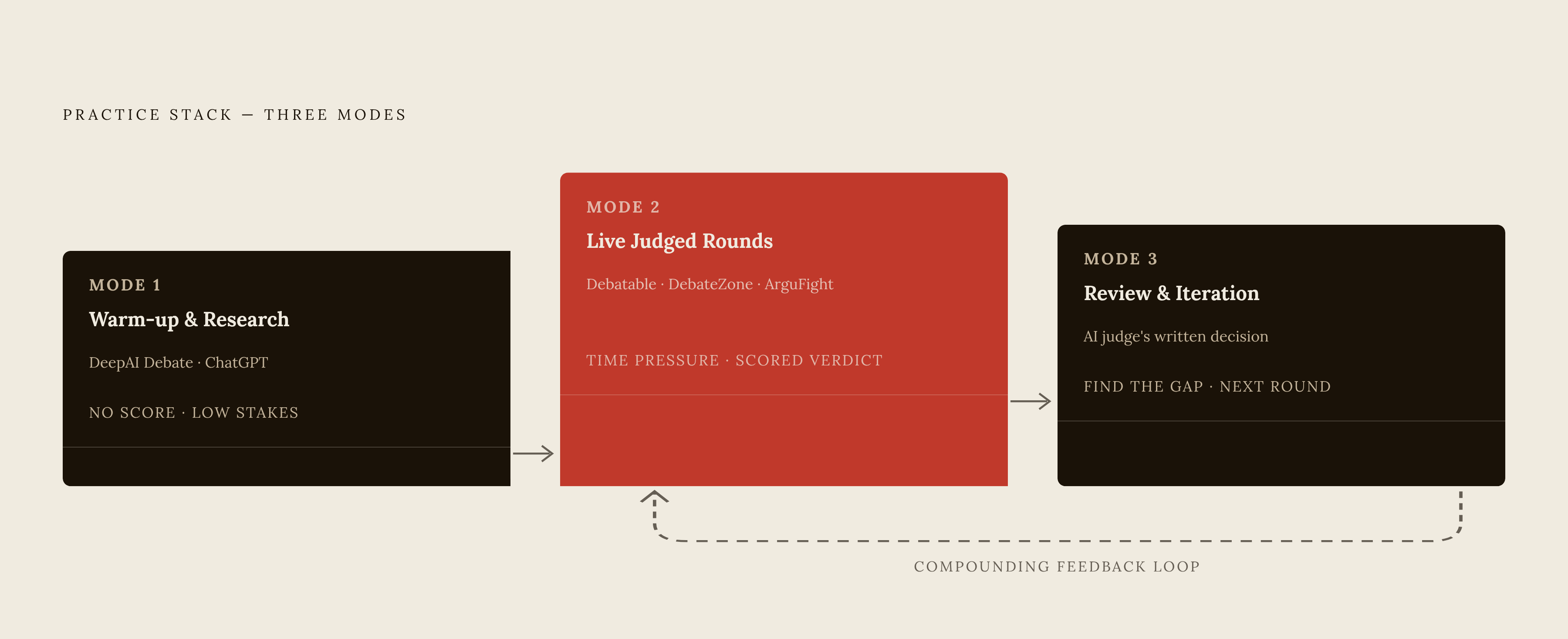
The fastest route to improvement for a casual user is a three-mode stack: AI sparring to warm up, live judged rounds to develop real pressure skills, and scored feedback to close the loop. No single platform does everything, but if you use the modes deliberately, the combination works. Mode 1 is warm-up and research. Use DeepAI Debate or ChatGPT to explore a topic and stress-test your initial arguments before you commit to a live round. The stakes are low, there is no score, and it is good for identifying obvious gaps.
Mode 2 is live judged rounds, on platforms like Debatable, DebateZone, and ArguFight. This is the core of the practice stack. A real or AI opponent under time pressure, with a scored verdict that cites what was said, is where improvement actually compounds. Mode 3 is review and iteration. Read the AI judge's written decision and identify the specific argument or exchange that moved the score. The next round, address that gap. This is the feedback loop that text-based or unjudged practice cannot provide. For users who want community and stakes beyond the round itself, Debatable's public leaderboard, separate ranking for live and AI rounds, and creator matchup opportunities give the practice habit a social dimension that sustains motivation past the first few sessions. This is where the live, one-on-one, judged tier earns its place. It matches what the casual user needed from the start, and it fits naturally into a habit that the evidence says will make a person sharper.