Three-Model AI Judge Panels vs Single-Model Verdicts
Independent judges, shared criteria, and visible splits beat one verdict.
A three-model AI judge panel can make debate verdicts more trustworthy than a single-model verdict because independent judges can challenge one another’s reasoning. For a live voice debate platform with AI judging and a published scoring rubric, what matters most is that judges score on their own, show where they disagree, and share the criteria before the round. Three judges alone do not provide those safeguards.
Why asking one AI for a verdict is structurally different from asking a panel
A debater receives a verdict but cannot tell whether the round was close or decisive. The explanation sounds settled, yet nothing reveals whether another evaluative lens would have reversed the result. That is a structural gap.
Single-model verdicts often suffer from “confident plausibility. An answer can sound reasonable while concealing a weakness that becomes apparent only under challenge. Single-model overconfidence comes from training that pushes a model to give a clean answer even when the question is hard. A more capable model does not, on its own, show where others might disagree. For the losing debater, the missing information is whether the argument failed clearly or lost on a contested judgment.
What single-model bias actually looks like in a judging context
Length bias distorts the relationship between argument quality and score. A longer answer can register as more thorough even when its extra words add no evidence or logical force. In judging, elaboration then becomes a substitute for strength. A concise rebuttal may receive less credit than a sprawling response that leaves the central objection unanswered.
Self-model bias introduces a different distortion. A judge tends to favor outputs resembling its own training distribution, including arguments constructed as it would construct them. Familiarity can become an unspoken scoring criterion. The debater may therefore learn to build arguments in the form a model prefers rather than improve the reasoning that the form is meant to express.
Style-over-substance vulnerability makes that distinction harder to trust. Research validated at ICML 2024 and NeurIPS 2024 showed that even a nonsense “null” response could receive high rankings from a single evaluator when written in a sufficiently persuasive register. Because these biases operate silently, a verdict does not necessarily reveal whether logic, evidence, delivery, or the evaluator’s preferences determined the result. That uncertainty weakens feedback precisely when the debater needs a diagnosis.
How adversarial cross-checking between independent models addresses each failure mode
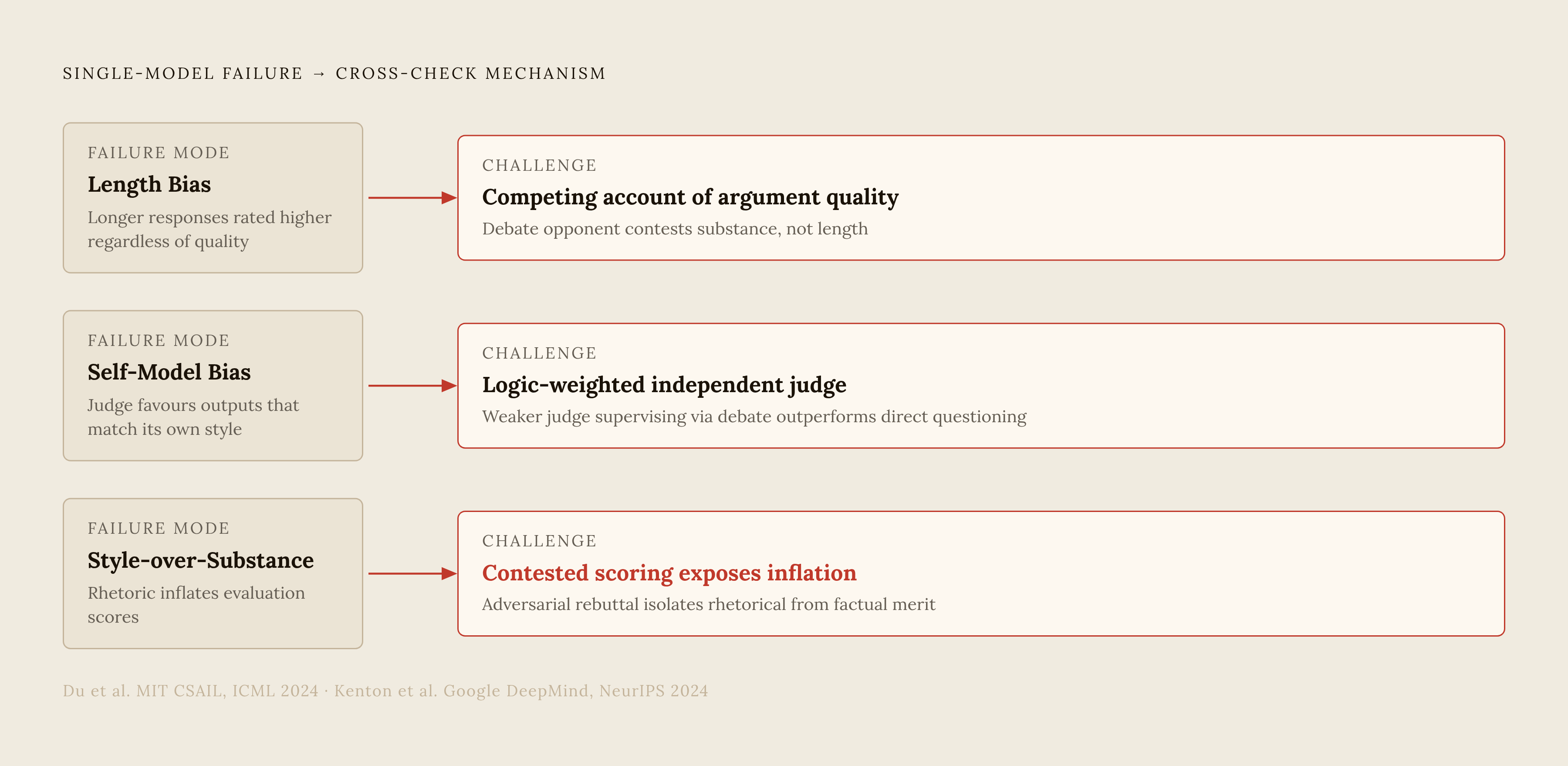
Adversarial cross-checking changes the task from issuing an assessment to defending it against another assessment. Independent models evaluate the same material and challenge one another’s claims through an exchange. A judgment based on length can face a competing account of argument quality, while a stylistic preference can encounter a judge that gives greater weight to logical substance.
This creates a route to correction that averaging alone lacks. A rhetorically inflated argument that persuades one evaluator still faces others that may weight it differently. Those evaluators can contest the reason for the score. Their disagreement also produces useful information. It exposes a contested reading that a single polished verdict would leave hidden.
Du et al. of MIT CSAIL, in work presented at ICML 2024, found that models correcting one another through debate improved factuality and reasoning. Kenton et al. of Google DeepMind, at NeurIPS 2024, found that a weaker judge supervising stronger models through debate outperformed direct questioning on every task studied. Wang et al. of Together AI and Stanford, at ICLR 2025, showed that collective reasoning could surpass individual model capability. These findings support debate as an oversight mechanism. They do not establish that every three-model judging panel will work, which makes panel composition the next design question.
Why model diversity within the panel matters as much as the panel format itself
Three instances of the same base model can reproduce the same preferences. They may agree because they share training, without the case being any stronger. Different model names are not enough either. For real diversity, judges need different training backgrounds, architectures, and scoring paradigms, so that what one judge misses is not automatically missed by the others.
Distinct evaluative roles make that diversity useful to a debater. A judge that weighs factual accuracy is making a different claim from one that weighs logical structure or persuasive effectiveness. The disagreement then has an identifiable source. If the factual assessment is strong but the logical assessment is weak, the result points toward a problem in how the evidence supports the conclusion.
Agreement across those perspectives provides stronger grounds for confidence than repetition of one model’s judgment. A split, by contrast, identifies the dimension on which the assessments diverge. Human competitive debate panels work in a similar way. No single judge’s idiosyncrasy determines the outcome, and dissent remains part of the record.
The genuine objection: multi-model panels can amplify bias rather than cancel it
Multi-agent debate can make evaluation worse. Research on multi-agent debate in LLM-as-Judge evaluation found that biases grew after the first round and stayed high in later rounds. Further discussion did not repair the distortion. Under those conditions, deliberation gave an existing mistake more support.
“Collaborative hallucination” describes a related failure among weaker models. One agent advances a shaky reading, the others lack the capacity to detect its weakness, and the group ratifies it with collective confidence. The appearance of scrutiny becomes misleading. Hedging is not a reliable safeguard either, because the systems most likely to be wrong can also hedge most in their outputs. A reviewer who treats qualification as evidence of diligence can miss the underlying error.
These findings change the requirements for a defensible panel. Model diversity, independent scoring before deliberation, and a separate synthesizing judge outside the panel become safeguards. With strong, diverse models, deliberation toward consensus can work because a capable peer can catch an error. With weaker models, independent voting before discussion is safer because it prevents one confident but mistaken agent from influencing the others before ballots are cast.
The distinction is consequential for interpreting a unanimous verdict. Judges can reach consensus by correcting an error or by passing it around the group. The final vote alone cannot distinguish them. The way a panel is built must therefore be judged alongside its result, since agreement alone does not prove that the process was sound.
What deliberation between AI judges actually looks like — and what it reveals
UNC School of Law’s mock trial, conducted Oct. 24, 2025, at the Converge-Con AI Festival, made a change of judgment visible. ChatGPT, Claude, and Grok acted as jurors in a trial based on a real North Carolina juvenile case. ChatGPT initially leaned toward conviction. After deliberating with the other jurors, it changed position, citing the prosecution’s failure to prove shared intent and noting that “the record here is ambiguous.” All three converged on acquittal, unlike the human judge’s guilty finding in the real case.
The useful observation is the reason for the change. Deliberation exposed a dispute about what the evidence established. Dean Andy Hessick framed the experiment around what happens when the human element is removed from deliberation. The outcome shows how another evaluator’s argument can bring a decisive evidentiary question into view.
UNC’s mock Supreme Court oral argument on Oct. 22, 2026, illustrated differentiated reasoning. Three AI justices, assigned textualist, pragmatist, and progressive approaches, heard two students argue a real immigration case. The panel ruled 2-1 for the petitioner, matching the outcome of the actual U.S. Supreme Court in 2025. The textualist model dissented, mirroring the dissent of Justices Thomas, Alito, Kavanaugh, and Barrett in the real case.
The Council system built on Hermes provides a secondary illustration of how such movement can be presented. Jurors that change position receive a “⇄ changed” badge, while confidence rises when a 2-1 split is argued into consensus and falls when it is not. Disagreement becomes part of the reported result. That visibility remains distinct from human judgment, as Associate Dean Nicole Downing concluded. “AI reasons in a way that is similar to humans, but it does not yet act in a way that is similar to humans. There is still an enormous gap before an AI judge feels human.”
What should a live voice debate platform show beyond a single AI score?
A useful panel verdict identifies where judges agreed, where they split, and what each assessed on a named dimension. Consistent scores across logic, clarity, and persuasion provide stronger grounds for confidence than one model’s unexplained preference. Strong logic and clarity combined with weak response quality identify a specific weakness.
That distinction connects judging to improvement. Competitive debate coaches use feedback to locate the dimension that cost the round. A multi-dimensional verdict can serve that purpose when the criteria are clear. Without named criteria, three scores can be as hard to make sense of as one, because the debater cannot tell why they differ.
A published scoring rubric is therefore a prerequisite. Before the round, the debater needs to know what the judges will measure. Afterward, the decision needs to connect those measures to the performance. For students practising live spoken debate, this makes the evaluation legible as feedback on what they actually said rather than an opaque assessment they must learn to accommodate.
Appeal to a human reviewer and a platform that earns nothing based on who wins provide structural protections around the verdict. Presentation can preserve transparency without making every result cumbersome. The Council framework, for example, collapses its dissent panel by default while leaving it available when the confidence number gives the reader reason to examine the disagreement.
Why the panel format matters more as AI judging becomes standard in debate practice
As automated judging becomes part of regular practice, its preferences can shape what debaters learn to repeat. A system that rewards length or polish can turn those biases into training incentives. The debater must still argue in real time, and the panel judges what was actually said.
Debate practice is closer to chess training than classroom discussion in requiring a real opponent, a real score, and actionable feedback. Structured judging that draws on more than one perspective can bring that feedback to debaters outside expensive competitive tournaments. Model diversity, independent scoring, a separate synthesizing judge, pre-published criteria, and citable decisions govern whether the result can support improvement.
For a debater choosing a practice system, the practical test is whether its verdict explains where the round was lost. A published rubric shows the standards before practice begins, while visible dissent shows where judges had trouble applying them. Human review gives the debater a way to challenge the outcome. Choosing those features makes the judging process part of the training decision, rather than something accepted only after the score arrives.
Sources
- AI Jury Finds Teen Not Guilty in Mock Trial
- AI jury finds teen not guilty
- AI justices got the right answer at Carolina Law. The students who argued before them say something was still missing.
- Humans Correct Their Judgments Through Debate, but Weaker AI Models Do Not
- Judging with Many Minds: Do More Perspectives Mean Less Prejudice? On Bias Amplification and Resistance in Multi-Agent Based LLM-as-Judge - ACL Anthology
- Aligned Agents, Biased Swarm: Measuring Bias Amplification in Multi-Agent Systems